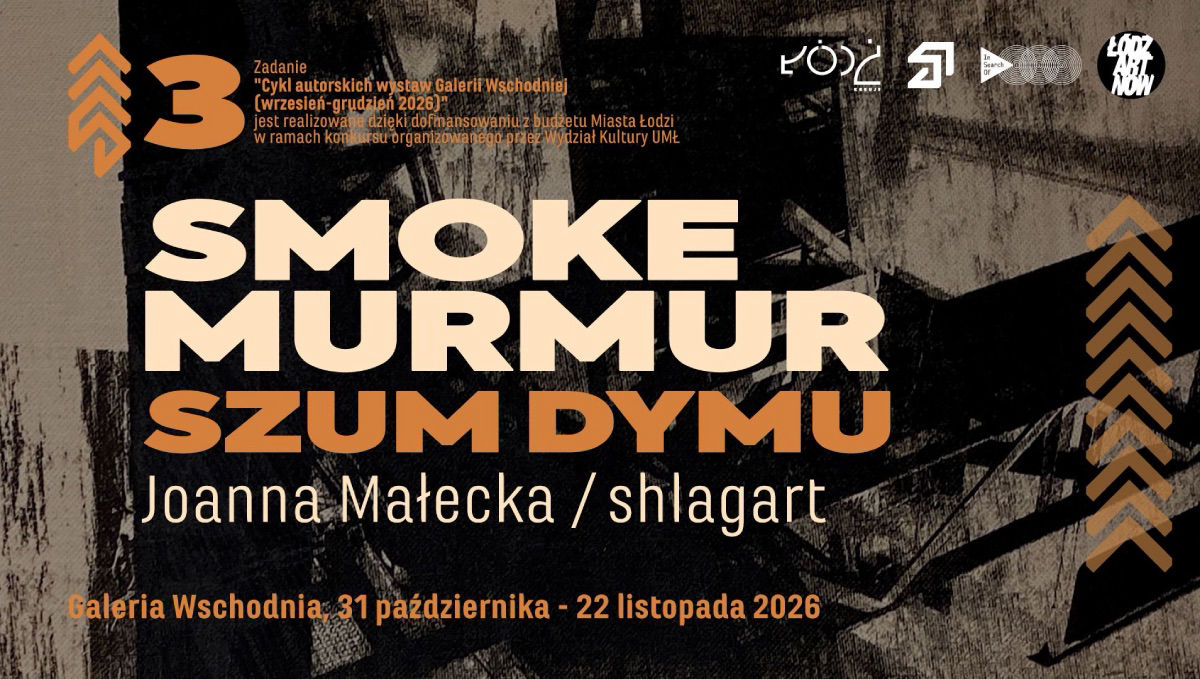
Smoke Murmur / Joanna Małecka / shlagart
curator: Wiktor Skok
The exhibition is open on 31 October – 22 November
Gallery Open
Mon. – Fri. from 7:00 p.m. to 8:00 p.m.
Sat. – Sun. from 2:00 p.m. to 5:00 p.m.
or by phone: Adam Klimczak, 793 434 420
____
Project 3, “A series of original exhibitions at Galeria Wschodnia (September–December 2026)”, is being carried out thanks to funding from the City of Łódź’s budget as part of a competition organised by the Culture Department of the City of Łódź
•
SZUM DYMU is a site-specific exhibition, created especially for the unique space of Galeria Wschodnia – a place that provides a symbolic framework for my personal narrative. Housed in a tenement building, the gallery resembles a childhood courtyard – a concrete well of sounds, a place of memories and a record of everyday life. It is from this topography that a new form emerges – a conceptual spatial installation, set within the physical and symbolic landscape of Łódź. The exhibition not only evokes a sensory memory of the city, but also subjects it to both artistic reconstruction and deconstruction. The gallery, as a place, becomes a space of transition – between the past and the present, the individual and the collective, the physical and the spiritual.
SZUM DYMU is a multimedia reflection on the urban landscape of the place where I was born and raised. It is an artistic narrative about the view from the windows of a concrete courtyard on Piotrkowska Street and the passageways with their peeling walls, as well as about the deeply rooted industrial character, filled with smoke from chimneys, dust and noise. It is a visual and sensory record of Łódź – the city I remember from my childhood and the one I know today, where the past intertwines with the present. The project comprises monochromatic graphic works, paintings and sound installations, capturing the austerity and melancholy of Łódź’s landscape.
The exhibition SMOKE MURMUR / SZUM DYMU is a reflection on presence, memory and the cyclical nature of existence. Its starting point is the experience of the ‘here and now’ – a moment in which change is not a separate event, but reveals itself as a natural and constant feature of reality.
No form is definitive. Each contains traces of what has passed and the potential of what may yet emerge. Life, death and rebirth do not function here as opposing states, but as interpenetrating stages of a continuous process of transformation. Matter becomes a vessel of memory, and its transformations reveal the tension between persistence and disappearance, presence and absence. Smoke becomes a trace of absence – a fleeting testimony to what has passed, yet still endures in the memory of matter.
That which appears motionless remains in a constant state of flux. That which fades does not cease to exist, but takes on a different form. The economy of expression, the monochromatic palette and the reduction of form direct attention towards the fundamental properties of matter and its capacity for transformation. Nature is not the subject of representation here, but rather the organising principle for thinking about reality – a ceaseless process of the emergence, disintegration and re-emergence of forms.
Fragmentary structures, geometric divisions and the rhythms of industrial spaces are reflected in compositions where the order of form meets the expression of matter. In the screen-printed works on raw canvas and linen, the natural texture of the substrate becomes an integral part of the image. The organic nature of the fibres, the irregularity of the marks and the variation in the saturation of the black stand in tension with the geometric order of the composition. The rawness of the material coexists with the rawness of the industrial landscape, creating a space in which the image does not so much reproduce reality as preserve the memory of its transformations. The experience of presence is explored in the installation *I Am Here and Now*, in which a steel bowl filled with water becomes a space for reflection and contemplation.
The accompanying sounds of breathing and a heartbeat evoke the fundamental rhythm of human existence. Water, steel and sound establish a relationship between the materiality of the object and the immaterial experience of time. The reflection, subject to subtle changes, becomes a metaphor for impermanence and constant becoming.
SMOKE MURMUR / SZUM DYMU is an invitation to pause and experience
the present – the moment in which memory, matter and time intertwine, revealing the fragility, continuity and constant transformation of existence.
•
Joanna Małecka is a visual ar(st, painter, and printmaker with a PhD in Fine Arts. Her
interdisciplinary prac(ce encompasses pain(ng, printmaking, sculptural objects, and installa(ons incorpora(ng sound and light. Her work explores themes of presence, memory, and impermanence, focusing on the transforma(on of maDer and the rela(onships between form, material structure, and space
She lives and works in Łódź, where she develops her independent ar(s(c project, shlagart. She is affiliated with Jan Kochanowski University in Kielce, where she heads the Screen Prin(ng Studio. She has par(cipated in interna(onal ar(st residencies and is the recipient of fellowships and awards. Her work has been featured in numerous solo and group exhibi(ons na(onally and interna(onally, including in the United States, across Europe, Peru, South Korea, and beyond.
www.shlagart.com
pdf (81,8 MB) >
red. Tomasz Załuski, Daniel Muzyczuk
projekt i skład: Piotrek Bdsn Okrasa
fot.: perspektywa.biz.pl
wydawcy: Fundacja In Search Of, Muzeum Sztuki w Łodzi
pdf (7,4 MB) >
redakcja / edited by: Helena Sej
The book 'Galeria Wschodnia. Documents 1984-2017 / Documents 1984-2017', edited by Daniel Muzyczuk and Tomasz Załuski, is a monumental study of the history of one of the longest-established authorial art spaces in Poland. The Wschodnia Gallery is an important example of artists' self-organisation and a centre whose history is symptomatic of transformations in the independent gallery movement. This nodal place on the map of Polish art also reveals how many shades the concept of independence can have.
Galeria Wschodnia was founded in 1984 on the initiative of, among others, Jerzy Grzegorski and Adam Klimczak, who took over the flat at 29 Wschodnia Street from the troupe Arlekin i Pantalon, run by Jarosław Orłowski, Piotr Bikont and Wojciech Czajkowski. The place, where various forms of creativity originally intersected and theatre rehearsals, free jazz sessions and political activity were the order of the day, became an important spot for independent art from the mid-1980s onwards. The gallery and its creators were also involved in important artistic initiatives taking place in Lodz, such as the subsequent Constructions in Process and the Artists' Museum. The leading artistic forms within its programme were installations and performances, clearly indicating a strategy of expanding the autonomy of the artist. Author's galleries were, after all, founded precisely in order to give all the power over the conditions for the presentation of art to its creators.
The main part of the book is a detailed study by Tomasz Załuski focused on the activities of the gallery in the broad context of the situation of other, related centres and organisations. It also contains a set of archival texts related to the East, written by Jerzy Busza, Jolanta Ciesielska, Maciej Cholewiński, Adam Klimczak, Maria Morzuch and Józef Robakowski. The content is complemented by materials related to the gallery's anniversary exhibition held at the Museum of Art in 2014, including texts by Daniel Muzyczuk and Mikołaj Iwański, as well as a calendar and an extensive photographic archive that gives an idea of the diversity of artistic forms hosted at Eastern over the years.
The publisher of the book is the Wschodnia Gallery / In Search Of... Foundation, and the co-publisher is the Muzeum Sztuki in Łódź. The publication was co-financed by the City of Lodz Office as part of the Publishing Programme.


Drag & Drop Website Builder